
Parking Lot Lighting Repair vs LED Retrofit: When to Replace
A dark parking lot gets noticed by the wrong people first: a tenant, a customer walking to their car, an insurance adjuster. The work order that follows usually says 'fix the light,' but the real decision is bigger than one fixture. Every repair on an aging metal-halide or high-pressure-sodium system is money spent on equipment that's on its way out. Here's how to tell when a repair is the right call and when it's time to convert the lot to LED.
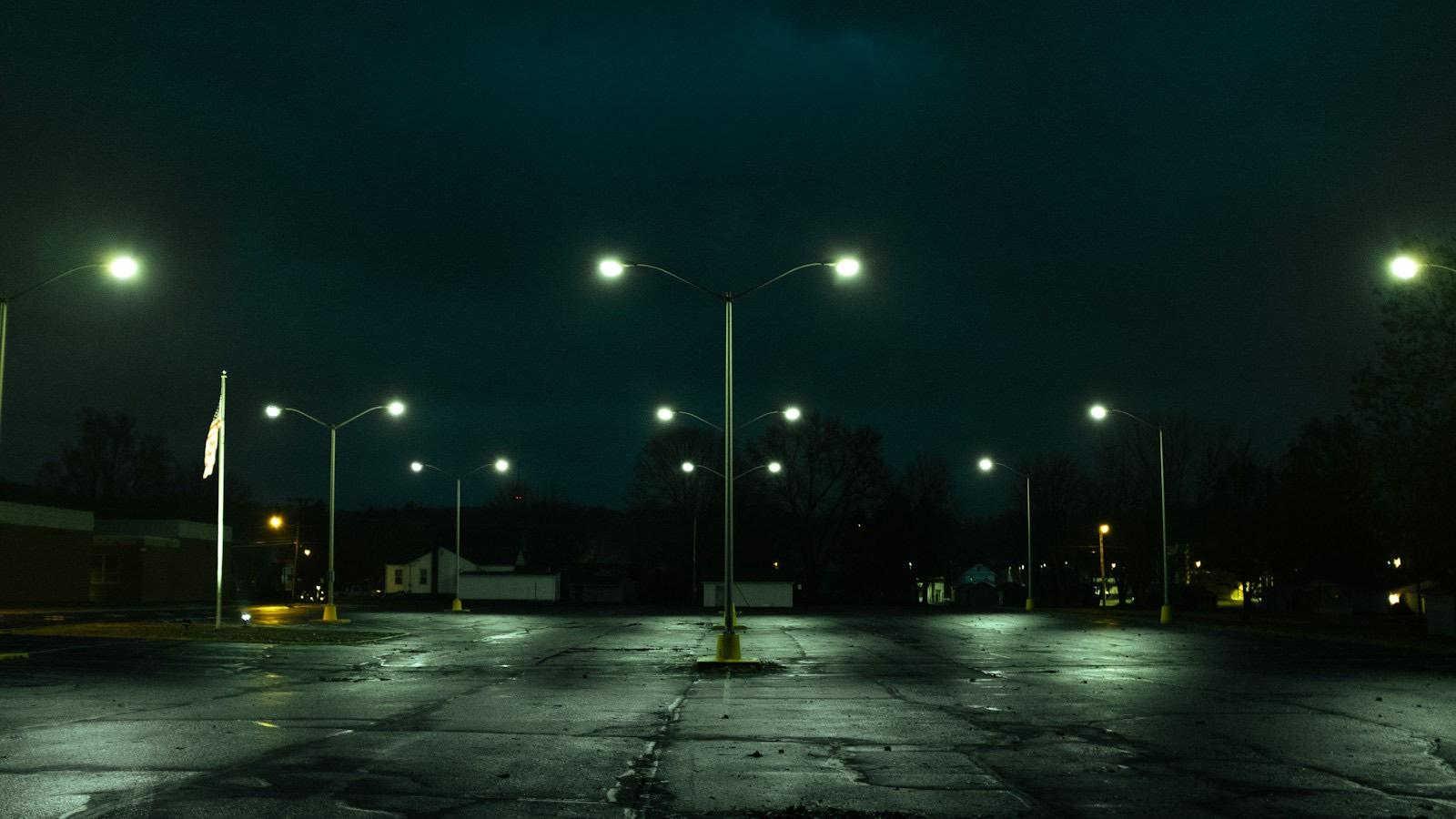
Should you repair a parking lot light or replace it with LED?
Repair when the fixtures are already LED or the problem is in the wiring, the controls, or a single component on an otherwise healthy system. Retrofit when the lot still runs metal-halide or high-pressure-sodium fixtures and failures are becoming routine — at that point each repair is a lift-truck visit spent on obsolete parts.
The tipping point is rarely one light. It's the pattern: repeat calls to the same lot, lamps and ballasts that are getting harder to source, uneven color and brightness from pole to pole, and an electric bill that reflects technology from two generations ago.
Why is a parking lot light out in the first place?
A dark pole has five usual causes: a failed lamp, a failed ballast or driver, a bad photocell or time clock, a tripped breaker or blown fuse, or a wiring fault — often underground or at the pole base. The fix and the cost are very different for each, which is why diagnosis comes before any quote.
One fixture out typically points to the lamp, ballast, or driver in that head. A whole row or the entire lot out points upstream: the control, the contactor, the breaker, or the feeder. Lights that stay on all day are almost always a photocell or time-clock failure. And a breaker that trips again after reset is a fault that needs to be found, not reset a third time.
- Single fixture dark: lamp, ballast, driver, or in-pole fuse
- Several poles on one circuit dark: breaker, contactor, or underground feeder
- Lights on during the day: photocell or time clock
- Lights cycling on and off: end-of-life lamp or failing ballast
- Breaker won't hold: ground fault, damaged conductor, or water in a pole base or splice
- Pole leaning or base damaged: vehicle impact — a structural issue before an electrical one
When does repair make sense?
Repair is the right answer when the system is fundamentally sound: LED fixtures within their service life, a control or wiring problem unrelated to the fixtures themselves, damage from a specific event like a vehicle strike, or a property where a larger project is already planned and the lot just needs to stay lit until then.
Underground faults are their own category. If a feeder has failed between poles, converting to LED doesn't fix it — the conductor still has to be located and repaired or replaced. The same goes for failed contactors, corroded pole-base splices, and damaged hand-hole wiring. Those are repairs regardless of what's at the top of the pole.
When does an LED retrofit make more sense?
A retrofit makes more sense when the lot is still on HID lighting and you're paying for repeated service calls. LED fixtures use substantially less energy than the metal-halide and high-pressure-sodium fixtures they replace, last far longer between service visits, and deliver more even light — so the conversion reduces both the power bill and the maintenance line.
The maintenance savings are often the stronger argument. Every HID lamp or ballast replacement needs a bucket truck and an electrician. A lot that goes years without one of those visits changes the operating budget more predictably than the energy savings do.
There's also a quality difference tenants notice: consistent color, no warm-up delay after a power blip, and optics that put light on the pavement instead of into the sky or the neighbor's windows.
- Fixtures are metal-halide or high-pressure-sodium
- Two or more service calls to the same lot in a year
- Replacement lamps or ballasts are discontinued or slow to source
- Visibly uneven lighting or dark zones between poles
- Complaints from tenants, customers, or security
- An energy or sustainability goal on the property
What are the retrofit options?
There are two practical paths: replace the whole fixture head with a new LED luminaire on the existing pole, or install an LED retrofit kit inside the existing housing. Full fixture replacement is the more common choice because it brings new optics, a new housing, and a full manufacturer warranty.
Existing poles and wiring are usually reused, which is what keeps a retrofit affordable — provided the poles are structurally sound and the underground wiring tests good. We check both before recommending anything. Adding controls at the same time, such as dimming during low-traffic hours or motion-based step-up, increases the savings and may be required by the energy code depending on the scope.
A lighting layout matters more than fixture wattage. Swapping one-for-one without checking coverage can leave the same dark spots at a lower power bill. A photometric layout confirms the new fixtures actually light the lot.
Are there incentives for parking lot LED retrofits in Oregon?
Often, yes. Energy Trust of Oregon offers cash incentives on qualifying commercial lighting upgrades for customers of PGE and Pacific Power, and exterior lighting conversions frequently qualify. Incentives depend on the existing and proposed equipment and must be approved before the work is done.
Paramount Electric Co. is an Energy Trust of Oregon Trade Ally contractor. We run the numbers, submit the application, and handle the paperwork, so the incentive is confirmed in the proposal rather than hoped for afterward.
How do you decide for a specific property?
Start with an assessment: what's installed, what's failed and why, the condition of poles and underground wiring, and the lot's service history. From there we price the repair and, where it's warranted, the retrofit side by side — so the decision is made on numbers for that property, not a rule of thumb.
For property and facility managers with several sites, the same assessment across the portfolio shows which lots are worth converting now and which only need repairs.
Common questions
Can you repair parking lot lights without a full retrofit?
Do you need to replace the poles for an LED conversion?
Do you service wall packs, canopy lights, and sign lighting too?
Will a retrofit require a permit?
Dark lot or rising repair bills?
Request service for a repair, or ask for a side-by-side repair-versus-retrofit assessment with incentives included. (971) 471-7897.