
Commercial Electricians: What Portland GCs and Facility Managers Should Expect
The email landed at 6:12 a.m. Walk-in down, store opens at 7, NTE already on the work order. That's one kind of call for commercial electricians in Portland. The other is a bid set with a due date and a panel schedule nobody has field-verified. We do both out of Clackamas. Mixing them on one calendar is how a rough-in loses a day to a breaker across town.

Read the exclusions
The number is useless without the page that says what we didn't include. If the drawings never show the existing 400-amp board, the proposal says we haven't seen it. 'Match existing' on a board with no spaces is how you buy a change order.
Schematic sets get a budget and a list of assumptions. Not a hard number we invent so the GC can put us on a spreadsheet. Send the PDF. If it's too big for email, call and we'll point you at a place to drop it. The request itself lives on the commercial electrical page.
Payroll, not a broker
CCB 195783. Electrical contractor C818. The people on the tools are ours. Cat6 and the camera cable go in with the power when the walls are open, because a second company at rough-in is how sleeves get missed. You can hear a brokered job at the coordination meeting. Nobody in the room pulled the gear.
After the certificate of occupancy
Six sites, one vendor, photos when the ticket closes. Stay inside the not-to-exceed. If the repair needs more, stop and write it. Don't 'finish it' and explain on the invoice.
A dark compressor before breakfast and a 600-amp restaurant service are not the same dispatch. We keep them on different boards. Occupied buildings are the annoying ones, and they're most of Portland: a clinic at 8, a grocery that will not go dark on Saturday, a hotel wing with guests still in it. Egress lights stay on a circuit we are not killing. The building engineer gets the window in writing, not in the lobby.
Dates we won't fake
Switchgear is often 16 or 20 weeks. That date goes in the email before you lock the other trades. A stamped one-line, if the city wants one, means the engineer is on the first call. Finding out at plan review is how a month disappears.
Price and design together is electrical design. Something already failed (heat, no power, a breaker that won't hold) is emergency electrical service. Same license. Don't use the bid form for a burning smell.
What 'done' means
Typed schedules. As-builts that match the pulls, not the bid set's fantasy. A photo of the panel before the cover goes on, because next year nobody will remember which breaker is the walk-in. Punch while the ladder is still in the building. I've watched a floor stall on an exit light and a blank directory. Ridiculous, and it happens.
Ask who pulls the permit. Ask if the cable is in the number. Ask what happens when the ceiling doesn't match the sheet. Boring answers are the right ones. We pull it. It's in or it isn't. The change gets a price before we build it. Oregon work only.
A night in an occupied corridor
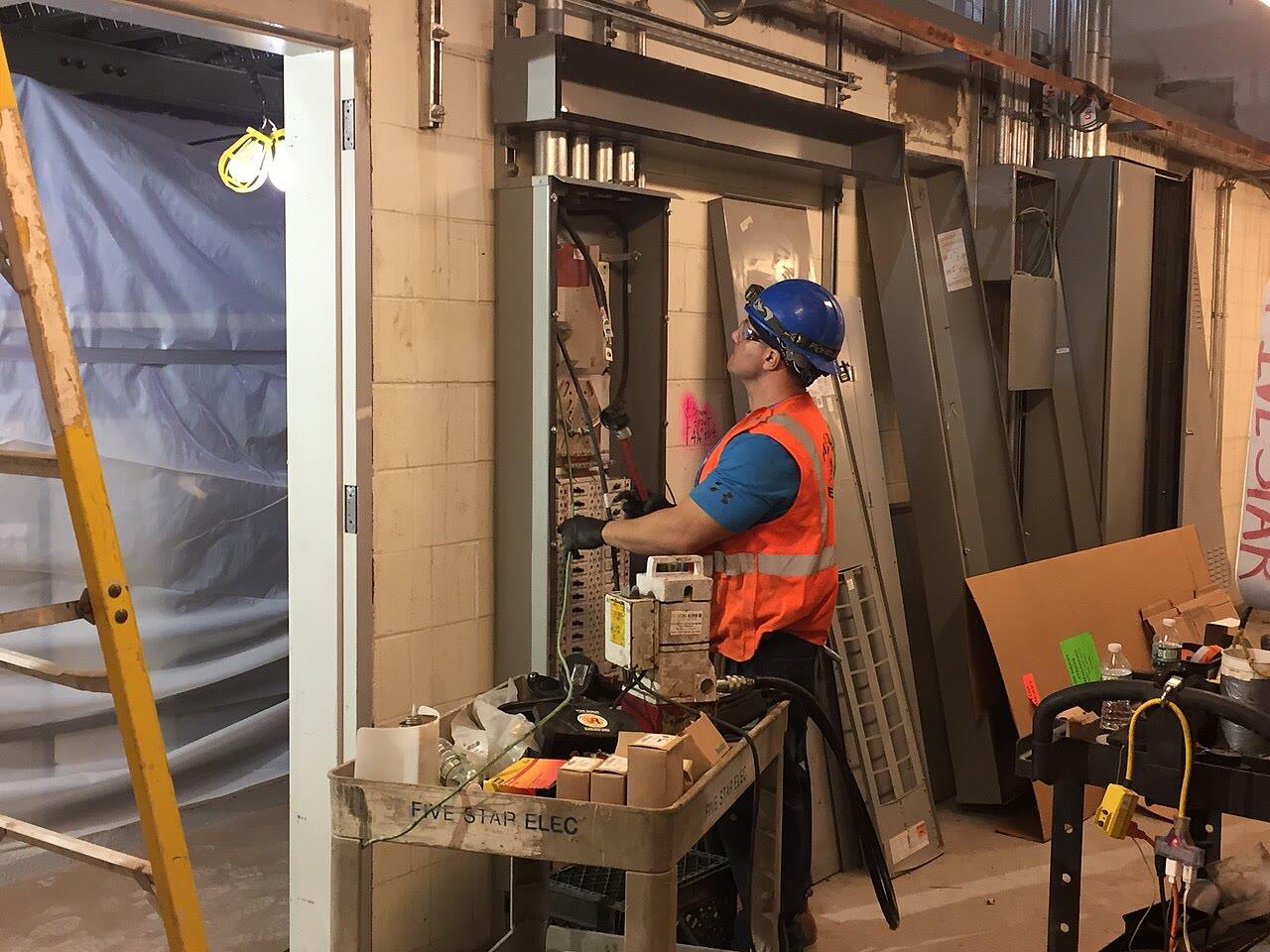
Dust wall up. Tiles stacked, not broken, if we can help it. One panel and maybe forty feet of corridor, because that's what the building will give you between 10 and 5. Material staged at 3 so we aren't waiting on a delivery when the freight elevator is locked. Egress heads on a circuit that is written down as do-not-kill. The engineer has the window on paper.
MC in the wall where the spec allows it. EMT where the corridor is exposed and the building cares how it looks at 8 a.m. THHN in that pipe, pulled, not stuffed. Labels on both ends before the cover goes back. If the ceiling doesn't match the homerun schedule, we stop and price it. We don't 'make it work' and explain on Friday.
Hand the floor back when we said we would. A hotel desk that can't check people into a dark wing does not care that our pull was pretty. Missing the hour is worse than a missed box. Closeout photos of the gear, breaker names that match the rooms, the roof disconnect actually where we said it was. Next year's service call is shorter because of that folder. Without it we're tracing a building we already wired, which is embarrassing and billable, and I'd rather not. Firestop on the sleeves the same day they're drilled. Coming back after the rock to caulk a hole you can't see is how inspections slip a week.
Vendor packet
COI, W-9, CCB 195783, electrical contractor C818. That's the packet. If a portal wants it uploaded a certain way, send the link. We don't invent extra credentials to make a form look fuller. Oregon is the license. The work we bid is Oregon work.
Common questions
Sub to the GC, or direct?
License numbers for the packet?
Power and cabling on one contract?
Change orders?
Where's the shop?
Set, or a work order
Bid date if you're building. NTE if something's already down.