
Is Your 100-Amp Panel Holding Your House Back?
A 100-amp panel was generous when your house was built. Then came the heat pump, the induction range, the dryer, the hot tub conversation, and the EV in the driveway. Here's how to tell when a panel is genuinely out of headroom, what an upgrade involves, and where the money goes.
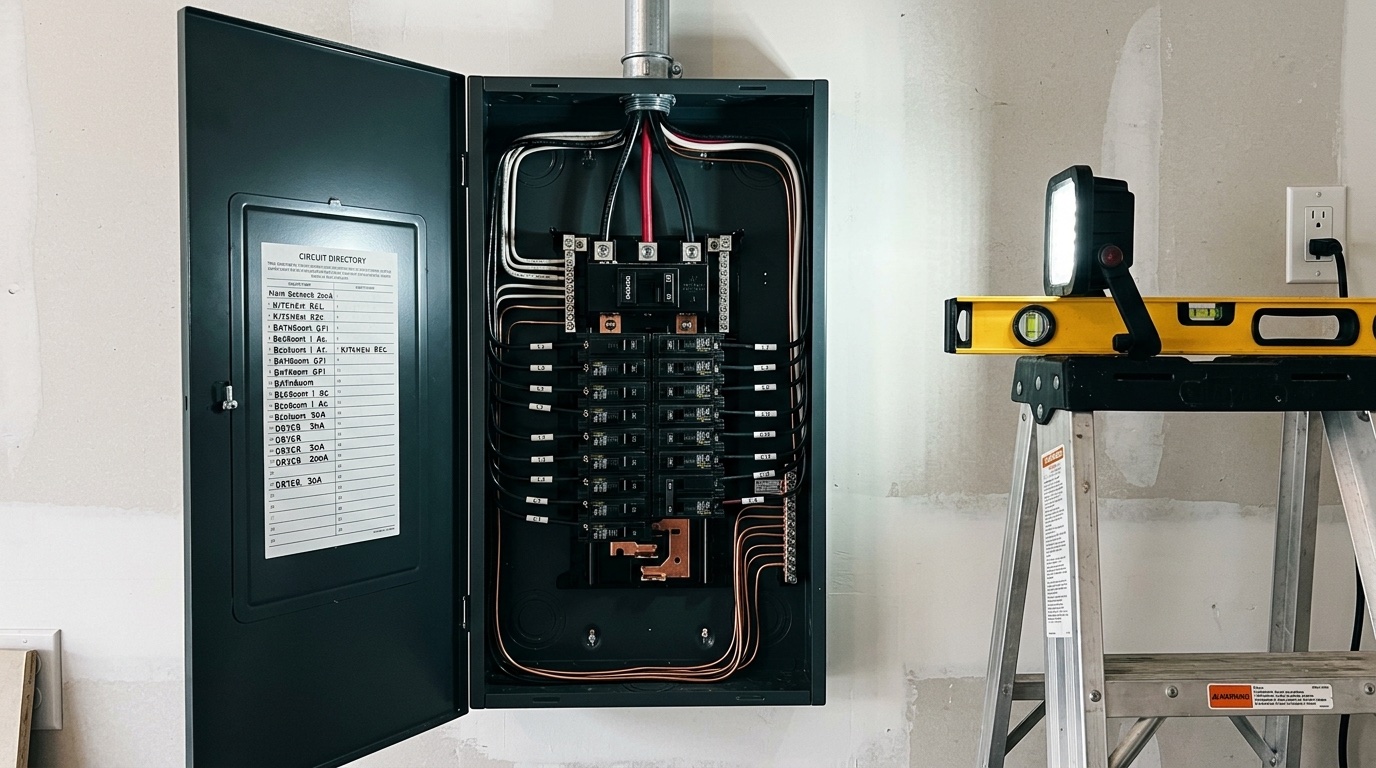
The signs a panel is out of headroom
Panels rarely fail loudly. The tells are quieter: breakers that trip when two big appliances run together, a panel with no open slots left, tandem breakers stacked where full-size ones should be, or a service that hums along fine until you ask an electrician to add one more circuit and they wince.
Age matters as much as amperage. Certain legacy panels (Zinsco and Federal Pacific are the notorious names) have documented failure modes where breakers don't trip under fault. If you have one of those, replacement is a safety decision, not a capacity one.
- Breakers trip when large loads overlap
- No open slots; tandem breakers everywhere
- Planning an EV charger, heat pump, ADU, or shop
- Zinsco, Federal Pacific, or fuse-box era equipment
- Flickering when the HVAC or dryer kicks on
Load calculation beats guesswork
The real answer to "do I need 200 amps?" comes from an NEC load calculation, not a rule of thumb. We total the square footage, fixed appliances, HVAC, and planned additions the way the code book prescribes. Plenty of homes asking about an upgrade turn out to have room once we do the math. Load-management devices can defer an upgrade by shedding an EV charger while the dryer runs.
That's also why a quote should start with questions about what you're planning: an EV, a shop, an in-law suite, not just what you have today. Sizing for the next ten years costs very little more than sizing for last year.
What a 200A upgrade involves
A service upgrade replaces the panel, the meter base, the service entrance conductors, and usually the grounding system, all permitted and inspected. The utility disconnects power for the working day; we coordinate that appointment so you're not surprised by the outage window.
In Oregon and Washington the permit and inspection are non-negotiable. An uninspected panel swap surfaces at appraisal or insurance renewal, and undoing someone else's shortcut costs more than doing it right once.
What drives the price
Three things move the number more than anything else: whether the service is overhead or underground, whether the existing location still meets code clearances, and how much circuit rework the new panel inherits. A straightforward like-for-like 200A upgrade is a one-day job; relocating a panel or trenching a new underground feed is not.
Ask any bidder to break those out separately. A single lump number hides where the real work is.
Common questions
Can I add an EV charger without upgrading my panel?
How long does a 200A service upgrade take?
Do you handle the permit?
Wondering what your panel can handle?
Send us a photo of your panel and what you're planning, and we'll tell you whether you need an upgrade or just smarter load management.