
Home EV Charger Installation in Oregon: What Actually Matters
Most EV charging questions aren't about the charger at all. They're about your electrical service. Before you buy hardware, here's what a licensed electrician checks: capacity, circuit routing, permit requirements, and the incentives that quietly pay for a chunk of the work.
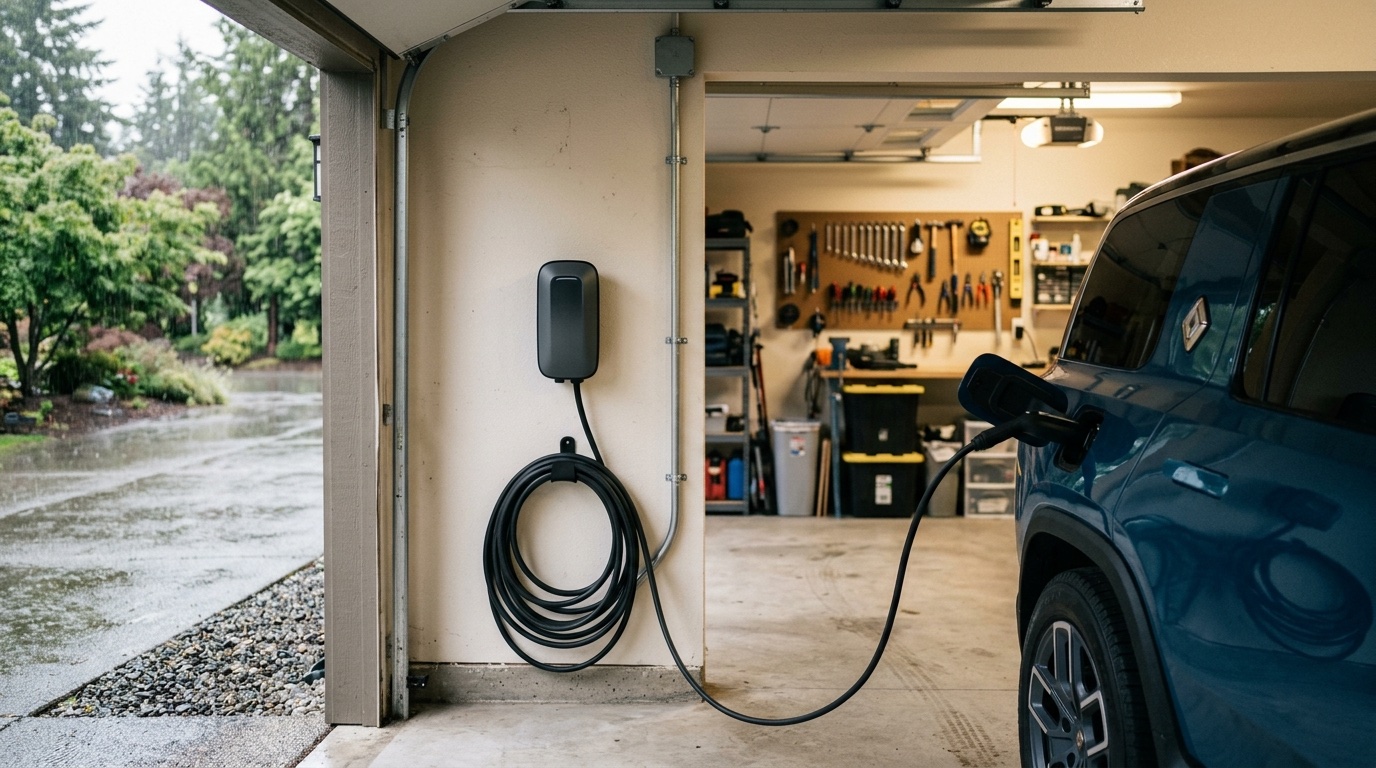
Level 2 is the answer for almost everyone
A standard wall outlet (Level 1) adds roughly 3–5 miles of range per hour: fine for a plug-in hybrid, painful for a full EV. A 240-volt Level 2 circuit adds 20–40 miles per hour and covers essentially every overnight-charging household.
The sizing question is the amperage: a 40A charger on a 50A circuit suits most drivers; 48A hardwired units charge faster but demand more panel headroom and a heavier feed. Bigger is not automatically better; it's paying for capacity your commute may never use.
Your panel decides how simple this is
The first thing we check is service capacity, the same NEC load calculation we run for panel upgrades. Homes with 200A service and gas heat usually take a Level 2 circuit without drama. Homes with 100A service, electric heat, or a full panel have options short of a service upgrade: a smaller charger circuit, or a load-management device that pauses charging while big appliances run.
Distance matters too. A garage panel ten feet from the charger location is an easy day; a run from a basement panel across the house to a detached garage is conduit, trenching, and a different bid. Placement flexibility is money.
- 200A service + gas appliances: usually straightforward
- 100A service: load calc first — load management often avoids an upgrade
- Detached garage: expect conduit or trenching in the bid
- Hardwired beats plug-in for 48A units and wet locations
Permits are required, and worth it
In Oregon and Washington, a new 240V circuit for EV charging requires an electrical permit and inspection, full stop. Beyond legality, the inspection matters because EV charging is the longest sustained load in your house: hours at full amperage, night after night. Loose terminations that survive a dryer cycle will cook on an EV circuit.
It's also what your insurer and future buyer will ask about. A permitted install is an asset; an unpermitted one is a liability with a cord attached.
Incentives: check before you schedule
Utility programs in our region regularly rebate a meaningful share of Level 2 installation. Programs change, but PGE, Pacific Power, and Clark PUD have all run residential charging incentives, and some require the installer's paperwork to qualify. Ask your electrician to handle the documentation; we do it as part of the job.
If you're also weighing a panel upgrade, sequence matters: some programs treat 'EV-ready' service upgrades favorably. One conversation up front can stack the incentives instead of missing them.
Common questions
Hardwired or plug-in charger?
How long does installation take?
Do you install chargers I bought myself?
Ready to charge at home?
Tell us your panel size and where the car sleeps, and we'll quote the circuit, pull the permit, and file the incentive paperwork.